The Complete History of Pluto: From Ancient Mythology to Modern Discovery and Reclassification
Abstract
Is Pluto still a planet? Good question. This site presents a comprehensive examination of Pluto’s history, from its mythological origins to its 1930 discovery, its role during the Space Race, its profound impact on popular culture, and its controversial 2006 reclassification as a dwarf planet. Because it was, and is, controversial to many citizens of Earth. The site explores recent scientific discoveries from NASA’s New Horizons mission and the James Webb Space Telescope that have transformed our understanding of this distant world. Through analysis of primary sources and scientific literature, this site demonstrates that Pluto’s status remains a subject of both scientific debate and cultural fascination, reflecting broader questions about how humanity defines and categorizes celestial objects.
Keywords: Pluto, dwarf planet, Kuiper Belt, planetary classification, New Horizons, astronomical history
Introduction
Pluto represents one of the most fascinating and controversial celestial objects in our solar system. For 76 years, it held the distinction of being the ninth planet from the Sun, capturing the imagination of generations and becoming deeply embedded in popular culture. Its 2006 reclassification to “dwarf planet” status sparked unprecedented public debate about the nature of planetary definition and humanity’s relationship with the cosmos. This paper traces Pluto’s complete history, from its mythological namesake through its discovery, its role in space exploration, its cultural impact, and the ongoing scientific revelations that continue to reshape our understanding of this distant world.
Ancient History and Mythological Origins
The name “Pluto” derives from ancient Roman mythology, where Pluto (or Pluton in Greek) was the god of the underworld and the dead (Hoyt, 1980). The Roman god Pluto was equivalent to the Greek god Hades, ruling over the realm of the deceased and associated with wealth hidden beneath the earth. This mythological connection would prove remarkably prescient when applied to the distant, dark world at the edge of our solar system.
When the celestial body was discovered in 1930, the astronomical community faced the task of naming humanity’s newest planetary discovery. The name “Pluto” was suggested by Venetia Burney, an eleven-year-old schoolgirl from Oxford, England. On March 14, 1930, Burney’s grandfather, Falconer Madan, mentioned the discovery over breakfast, and young Venetia proposed the name based on her knowledge of classical mythology (Library of Congress, 2025). Her grandfather forwarded the suggestion to the Lowell Observatory, where it was enthusiastically received. The name was particularly fitting for several reasons: it honored Percival Lowell (whose initials P.L. formed the first two letters), it continued the tradition of naming planets after Roman deities, and it reflected the dark, distant nature of this remote world.
Discovery and Early History (1930-1960)
The story of Pluto’s discovery begins not with its observation, but with mathematical prediction. In the 1840s, French astronomer Urbain Le Verrier successfully used Newtonian mechanics to predict the location of Neptune by analyzing perturbations in Uranus’s orbit. This triumph inspired astronomers to speculate that yet another planet might exist beyond Neptune, similarly disturbing the outer planets’ orbits (Hoyt, 1980).
Percival Lowell, a wealthy American astronomer, became obsessed with finding this hypothetical “Planet X.” He established the Lowell Observatory in Flagstaff, Arizona, specifically to search for trans-Neptunian objects. Lowell conducted extensive searches until his death in 1916, but never located the mysterious planet. The search continued sporadically until 1929, when the observatory acquired funding for a new astrograph and hired a young astronomer named Clyde Tombaugh (Hoyt, 1980).
Tombaugh’s task was monumental: systematically photograph regions of the sky where Planet X might be located, then compare photographs taken weeks apart to detect any moving objects. On February 18, 1930, while examining photographic plates taken in January, Tombaugh noticed a faint object that had shifted position between images. After confirming the discovery and calculating its orbit, the Lowell Observatory announced the finding on March 13, 1930—coincidentally, Percival Lowell’s birthday and the anniversary of William Herschel’s discovery of Uranus (Pickering, 1930).
The discovery was immediately hailed as the ninth planet, and excitement rippled through both the scientific community and the general public. However, questions about Pluto’s status emerged almost immediately. Early estimates suggested Pluto was smaller than expected for a planet capable of perturbing Neptune’s orbit. These initial doubts would prove prescient, though it would take decades of observations to reveal Pluto’s true nature (Putnam & Slipher, 1932).
Pluto During the Space Race Era (1960-1989)
The Space Race, sparked by the Soviet Union’s launch of Sputnik 1 in 1957, ushered in an era of unprecedented space exploration. While the initial focus remained on reaching the Moon and exploring the inner planets, Pluto captured the imagination of scientists and the public alike as the final frontier of planetary exploration.
During the 1960s and 1970s, ground-based observations gradually refined our understanding of Pluto. In 1965, astronomers determined that Pluto and Neptune are locked in a 3:2 orbital resonance, meaning Pluto completes exactly two orbits for every three of Neptune’s. This discovery explained why, despite Pluto’s orbit crossing Neptune’s path, the two worlds would never collide (Doressoundiram & Lellouch, 2010).
The most significant discovery of this era came in 1978, when astronomer James Christy detected a bulge in photographs of Pluto. This bulge proved to be a large moon, which Christy named Charon after the mythological ferryman who transported souls across the river Styx to Hades’ underworld. Charon’s discovery was revolutionary: it allowed astronomers to accurately calculate Pluto’s mass for the first time. The results were shocking—Pluto was far smaller and less massive than anyone had predicted, with only about 0.2% of Earth’s mass (Tyson, 2009).
The Voyager missions of the 1970s and 1980s, while transforming our understanding of Jupiter, Saturn, Uranus, and Neptune, could not visit Pluto. The spacecraft’s trajectories would not allow for a Pluto encounter, and the distant world remained largely mysterious. However, Voyager’s success in exploring the outer solar system sparked interest in eventually sending a mission to Pluto, planting the seeds for what would eventually become NASA’s New Horizons spacecraft.
Pluto’s Impact on Popular Culture
Pluto’s influence extended far beyond astronomy, becoming deeply embedded in popular culture throughout the 20th century. Remarkably, the planet’s discovery coincided with the creation of one of the world’s most recognizable cartoon characters: Disney’s Pluto the dog.
Walt Disney’s animated character Pluto made his debut on September 5, 1930, just months after the planet’s discovery, in the short film “The Chain Gang.” While Disney animator Ben Sharpsteen claimed uncertainty about why the name was chosen, many Disney animators believed Walt selected “Pluto” to capitalize on the excitement surrounding the newly discovered planet (D23, 2018). The character initially appeared as a nameless bloodhound but quickly became Mickey Mouse’s loyal pet. Unlike other Disney characters such as Goofy, Pluto remained non-anthropomorphic, communicating through pantomime and expression rather than speech—a unique characteristic that made him pioneering in character animation.
The Disney character’s popularity mirrored public fascination with the celestial Pluto. Between 1930 and 1953, Pluto appeared in 89 short films, with several receiving Academy Award nominations. The 1941 short “Lend a Paw” won the Oscar for Best Animated Short Film (Disney Fandom, 2024). The parallel existence of planetary Pluto and cartoon Pluto created a cultural synergy that kept both in the public consciousness for decades.
Beyond Disney, Pluto permeated educational materials, science fiction, and popular media throughout the 20th century. Elementary school students learned the mnemonic “My Very Educated Mother Just Served Us Nine Pizzas” to remember the planets’ order. Pluto represented the frontier of the known solar system, a mysterious world at the edge of sunlight. This romantic notion of Pluto as the solar system’s distant sentinel became deeply ingrained in popular imagination.
The Kuiper Belt and Growing Doubts (1990-2005)
The 1990s brought revolutionary changes to our understanding of the outer solar system. In 1992, astronomers David Jewitt and Jane Luu discovered the first Kuiper Belt object (KBO) beyond Pluto, designated 1992 QB1. This discovery confirmed the existence of the Kuiper Belt, a vast region of icy bodies extending from Neptune’s orbit to approximately 55 astronomical units from the Sun (Doressoundiram & Lellouch, 2010).
As telescope technology improved, astronomers discovered hundreds, then thousands of KBOs. Many were similar in size to Pluto, and some were comparable in composition. These discoveries raised uncomfortable questions: Was Pluto truly a planet, or merely the largest known member of the Kuiper Belt? The debate intensified in 2005 when astronomers discovered Eris, a KBO that appeared larger and more massive than Pluto (Britannica, 2025).
The Eris discovery forced the International Astronomical Union (IAU) to confront a fundamental question: What exactly is a planet? If Pluto remained a planet, should Eris also be classified as one? What about the dozens of other large KBOs being discovered? The astronomical community faced a choice: either expand the definition of planet to include potentially hundreds of objects, or create a new classification system.
The 2006 Reclassification: Pluto Becomes a Dwarf Planet
The 2006 General Assembly of the IAU in Prague became one of the most significant—and controversial—events in modern astronomical history. After intense debate, the IAU adopted a new definition of “planet” proposed by Uruguayan astronomers Julio Ángel Fernández and Gonzalo Tancredi (Library of Congress, 2025).
According to the new definition, a planet must satisfy three criteria:
- It must orbit the Sun
- It must have sufficient mass to assume hydrostatic equilibrium (a nearly round shape)
- It must have “cleared the neighborhood” around its orbit
Pluto satisfied the first two criteria but failed the third. Its orbit in the Kuiper Belt contains numerous other objects of comparable size that it has not gravitationally cleared. In contrast, Earth is 1.7 million times more massive than all other objects in its orbital neighborhood combined (excluding the Moon). Pluto’s mass is only 0.07 times that of other objects in its region (Wikipedia, 2025).
On August 24, 2006, the IAU voted to approve Resolution 5A, establishing the new definition, and Resolution 6A, which classified Pluto as a “dwarf planet”—the prototype of a new category of trans-Neptunian objects. The vote on Resolution 6A passed 237-157, with 30 abstentions, revealing the controversy within the scientific community itself (Wikipedia, 2025).
The decision triggered an immediate and passionate public reaction. News outlets worldwide covered the “demotion,” often using emotionally charged language. Textbooks required updating. Internet memes proliferated, depicting Pluto as heartbroken, angry, or ostracized from the planetary family. Many members of the public rejected the change, citing either the disagreement within the scientific community or emotional attachment to Pluto’s planetary status (NASA, 2025).
The controversy extended beyond public opinion. Many prominent planetary scientists criticized the IAU’s definition. Alan Stern, principal investigator of NASA’s New Horizons mission, argued that the “clearing the neighborhood” criterion was flawed, noting that no planet completely clears its orbit permanently. In 2021, Stern advocated for removing the term “dwarf” from the classification, arguing that Pluto and similar bodies are simply planets in different contexts (Orbital Today, 2024).
Planetary scientist Philip Metzger and colleagues published research arguing that the IAU definition contradicts how planetary scientists have historically used the term “planet” in scientific literature. They noted that the geophysical definition—a body massive enough to be rounded by its own gravity—better reflects scientific practice and would classify Pluto as a planet (Orbital Today, 2024).
Despite ongoing debate, the IAU’s decision remains the official classification. Currently, five dwarf planets are recognized: Ceres (in the asteroid belt), Pluto, Haumea, Makemake, and Eris (in the Kuiper Belt). However, the IAU acknowledges that potentially hundreds more await discovery (NASA, 2025).
The New Horizons Mission: Pluto Revealed (2015)
On July 14, 2015, NASA’s New Horizons spacecraft made history by conducting the first close flyby of Pluto, traveling at approximately 80,000 kilometers per hour. The mission, which launched on January 19, 2006—seven months before Pluto’s reclassification—transformed our understanding of this distant world (New Horizons, 2025).
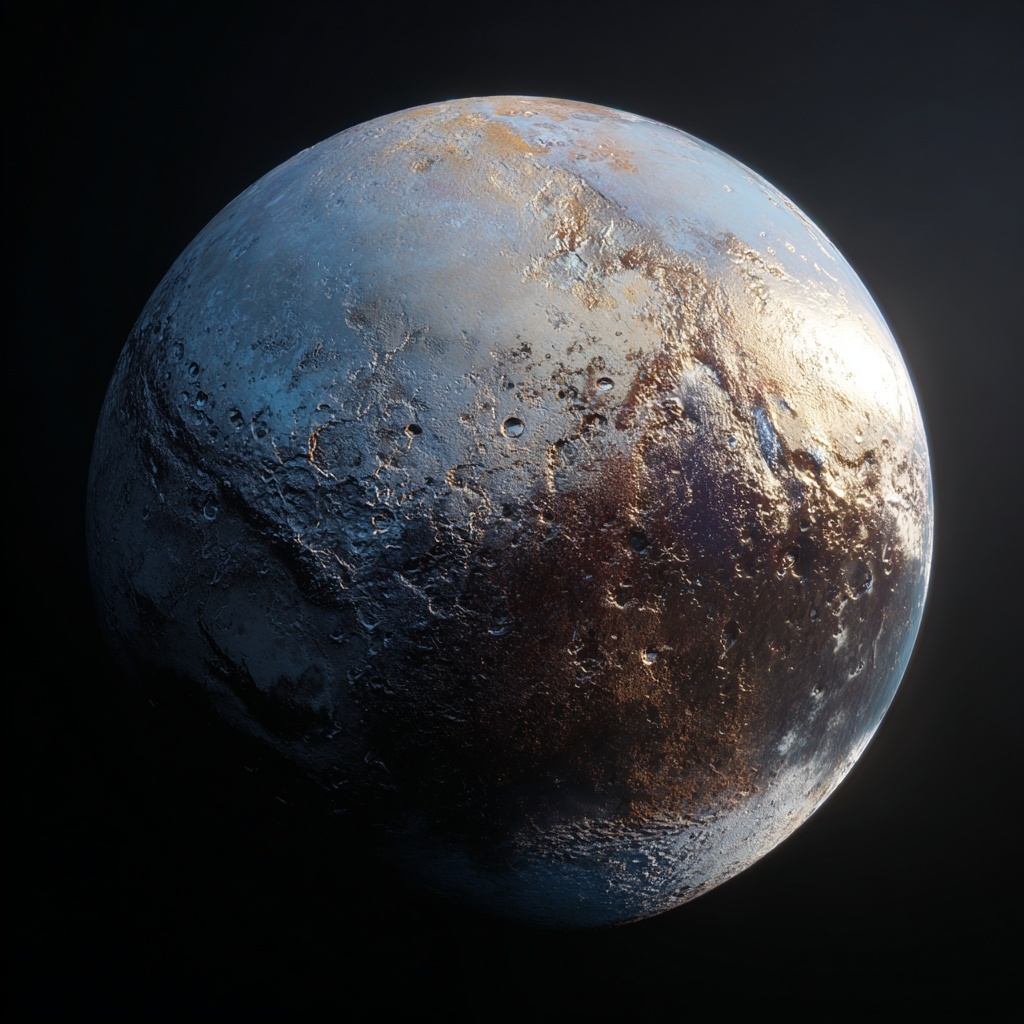
The images and data returned by New Horizons revealed a world far more complex and geologically active than scientists had anticipated. Pluto’s surface displayed an astonishing variety of features: towering water-ice mountains reaching 2-3 kilometers high, vast plains of frozen nitrogen showing no impact craters (suggesting recent resurfacing), strange polygonal patterns indicating convection, and peculiar “bladed terrain” consisting of 500-meter-high ridges separated by kilometer-wide gaps (NASA APOD, 2025).
One of the most striking features was Tombaugh Regio, an enormous heart-shaped plain of nitrogen ice. New research suggests this feature formed from a massive, slow-motion impact billions of years ago, with nitrogen ice accumulating in the resulting basin (Live Science, 2025).
The New Horizons mission also confirmed that Pluto possesses a thin, extended atmosphere composed primarily of nitrogen, with traces of methane and carbon monoxide. This atmosphere expands when Pluto approaches the Sun and collapses as it recedes, similar to a comet’s behavior (NASA, 2025).
Perhaps most intriguingly, the mission discovered evidence of cryovolcanism—ice volcanoes that erupt with water, ammonia, and other volatiles instead of molten rock. One feature, Kiladze Caldera (formerly Kiladze crater), may be a supervolcano that erupted relatively recently in geological terms, spewing ice across Pluto’s surface (Live Science, 2025).
The New Horizons mission also studied Charon in unprecedented detail, revealing a world with its own fascinating geology. Charon’s dark, reddish polar regions appear to result from capturing methane molecules escaping from Pluto’s atmosphere, which then undergo chemical transformation under solar radiation (UC Santa Cruz, 2025). This unique interaction—material from one world’s atmosphere settling on its moon—occurs nowhere else in the solar system.
After its Pluto encounter, New Horizons continued into the Kuiper Belt, conducting a successful flyby of the KBO Arrokoth (formerly known as 2014 MU69) on January 1, 2019. The spacecraft remains functional and is now headed out of the solar system, conducting valuable studies of the local interstellar medium (New Horizons, 2025).
Recent Discoveries and Ongoing Research (2020-2025)
The scientific study of Pluto continues to yield surprising discoveries, particularly through observations from the James Webb Space Telescope (JWST), which began operations in 2022.
In June 2025, scientists published groundbreaking research in Nature Astronomy based on JWST’s observations of Pluto. The telescope’s Mid-Infrared Instrument (MIRI) captured unprecedented data about Pluto’s atmosphere and thermal properties. Most significantly, the observations confirmed a controversial 2017 hypothesis by Xi Zhang, a professor at UC Santa Cruz, who proposed that Pluto’s atmosphere is dominated by haze particles that control the entire energy balance through heating and cooling—a phenomenon unlike any other atmosphere in the solar system (UC Santa Cruz, 2025).
Zhang’s prediction that these haze particles should emit strong mid-infrared radiation was definitively confirmed by JWST’s observations. The telescope also revealed dramatic seasonal cycles of volatile ice redistribution across Pluto’s surface and provided detailed measurements of surface thermal radiation during Pluto’s rotation. These data allowed researchers to constrain thermal inertia, emissivity, and temperature variations across different regions of both Pluto and Charon (UC Santa Cruz, 2025).
Additional recent research has explored Charon’s formation and evolution. A study presented at the 56th Lunar and Planetary Science Conference in 2025 investigated how Charon might have developed cryovolcanism and potentially harbored an internal ocean beneath its icy crust (Phys.org, 2025). Another 2025 study suggested that Pluto and Charon formed through a gentle, prolonged collision billions of years ago—a cosmic “kiss” lasting approximately 10 hours that left both bodies intact but bound together (Space.com, 2025).
Research on Pluto’s geological features continues as well. Scientists have determined that the “bladed terrain” near Pluto’s equator may be far more extensive than originally thought, with these bizarre methane-ice ridges covering larger areas than initial surveys suggested (Live Science, 2025).
The ongoing debate about Pluto’s status has also yielded interesting research. On February 18, 2030, Pluto will complete its first full orbit since its discovery—248 Earth years after Clyde Tombaugh first spotted it. This milestone has renewed calls from some scientists to reconsider its classification (Live Science, 2025).
Cultural Legacy and Public Perception
Despite—or perhaps because of—its controversial reclassification, Pluto remains extraordinarily popular in public consciousness. The 2006 “demotion” paradoxically increased public interest in and affection for the distant world. As science historian Owen Gingerich noted, “planet is a culturally defined word that changes over time,” and public sentiment continues to favor including Pluto among the planets (Space.com, 2022).
This emotional connection manifests in various ways. In 2014, before the New Horizons flyby, a public debate at the Harvard-Smithsonian Center for Astrophysics saw audience members overwhelmingly choose a planetary definition that would restore Pluto’s status (Space.com, 2022). The hashtag #PlutoLoversRejoice and similar social media movements periodically trend when new discoveries about Pluto are announced.
Educational materials face an ongoing challenge. While textbooks officially describe eight planets, many include special sections on Pluto and dwarf planets. The updated planetary mnemonic “My Very Educated Mother Just Served Us Nachos” never gained the popularity of its pizza-serving predecessor, perhaps reflecting public resistance to accepting only eight planets.
Interestingly, Disney’s Pluto character has experienced renewed popularity in conjunction with interest in the dwarf planet. The coincidence of their shared name and near-simultaneous debuts in 1930 continues to fascinate both Disney enthusiasts and astronomy buffs (D23, 2018).
Scientific Significance and Future Exploration
Regardless of its classification, Pluto’s scientific importance cannot be overstated. The New Horizons mission revealed that small, distant, cold worlds can remain geologically active billions of years after their formation. This discovery has profound implications for understanding planetary evolution, not just in our solar system but throughout the universe.
Pluto’s complex atmosphere, active geology, and interaction with its moons provide a natural laboratory for studying processes that occur under extreme conditions vastly different from Earth’s. The discovery of possible cryovolcanism and subsurface oceans suggests that exotic forms of geological activity may be far more common in the outer solar system than previously thought.
Future exploration remains a topic of active discussion. A proposed mission called “Persephone” would orbit Pluto and its moons for up to 50 years, conducting detailed studies that the brief New Horizons flyby could not accomplish (Live Science, 2025). However, such a mission faces significant funding and approval challenges, as reaching Pluto requires decades of flight time and substantial resources.
The newly discovered sednoid 2023 KQ14, found in 2025 far beyond Pluto, reminds us that the outer solar system continues to hold surprises (ScienceDaily, 2025). Each new discovery in the Kuiper Belt and beyond refines our understanding of solar system formation and the nature of planetary bodies.
Conclusion
Pluto’s history reflects humanity’s evolving relationship with the cosmos. From a mythological god of the underworld to a mathematical prediction, from a telescopic discovery that excited the world to a cartoon character that entertained millions, from the mysterious ninth planet to a controversial dwarf planet revealing unexpected geological wonders, Pluto has remained a constant source of fascination for nearly a century.
The controversy surrounding Pluto’s reclassification ultimately reveals more about human psychology and cultural attachment than about the nature of celestial mechanics. Whether classified as the ninth planet or the most famous dwarf planet, Pluto’s scientific importance and cultural significance remain undeniable. As Alan Stern eloquently stated, the debate over Pluto’s status may be less important than the discoveries we continue to make about this remarkable world.
The James Webb Space Telescope’s recent revelations, combined with ongoing analysis of New Horizons data, ensure that Pluto will continue yielding scientific insights for decades to come. Future generations may see dedicated orbital missions to Pluto, potentially revealing subsurface oceans, active cryovolcanoes, or other phenomena we cannot yet imagine.
Venetia Burney, who named Pluto as an eleven-year-old girl in 1930, lived to see the New Horizons flyby in 2015, shortly before her death. Her legacy—connecting an ancient god’s name to a distant world—endures as one of the most recognizable astronomical names in history. In this sense, Pluto’s greatest triumph may be how thoroughly it has captured human imagination, transcending scientific classifications to become a beloved cultural icon that inspires wonder about the mysteries lurking at the edge of our solar system.
Curious what else is out there in the vast reaches of space?
Just like Pluto, space is full of interesting objects. You need only take the time to look up every now and then. You’ll see planets, stars, galaxies, satellites and more. Once you start looking into space you start to realize Earth really isn’t that big after all. And you can start exploring space from anywhere. It starts with simply looking up and being curious about what’s out there. If you’re ready to see what else is out there, here are a few resources you can use on your exploration.
Space Telescope Live: Take a look through the largest telescopes in space by seeing what the Hubble and James Webb space telescopes are seeing. Take a look over at Space Telescope Live.
ISS Tracker: If you’ve ever wondered what’s orbiting Earth, you can track the path of the International Space Station (ISS), Starlink, and other satellites over at ISS Tracker.
ISS Live Now: This one offers a deeper dive into the International Space Station. You can see the live video feed from the ISS, current location, speed, and other info over at ISS Live Now.
Stellarium Star Map: Looking to know more about what you’re seeing in your own backyard? Stellarium will show you the sky map from you specific location. Give it a try over at Stellarium Star Map.
References
Britannica. (2025, June 13). Why is Pluto no longer a planet? https://www.britannica.com/story/why-is-pluto-no-longer-a-planet
D23. (2018, March 3). Pluto. https://d23.com/a-to-z/pluto/
Disney Fandom. (2024, October 29). Pluto. https://disney.fandom.com/wiki/Pluto
Doressoundiram, A., & Lellouch, E. (2010). At the edge of the solar system: Icy new worlds unveiled (B. Mizon, Trans.). Springer Verlag.
Hoyt, W. G. (1980). Planets X and Pluto. University of Arizona Press.
Library of Congress. (2025, February 25). Why is Pluto no longer a planet? https://www.loc.gov/everyday-mysteries/astronomy/item/why-is-pluto-no-longer-a-planet/
Live Science. (2025). Pluto: News, features and articles. https://www.livescience.com/space/astronomy/planets/pluto
National Aeronautics and Space Administration. (2025, April 29). Pluto. https://science.nasa.gov/dwarf-planets/pluto/
National Aeronautics and Space Administration. (2025, April 29). Pluto & dwarf planets. https://science.nasa.gov/dwarf-planets/
National Aeronautics and Space Administration. (2025, April 22). Pluto: Facts. https://science.nasa.gov/dwarf-planets/pluto/facts/
National Aeronautics and Space Administration, Astronomy Picture of the Day. (2025, May 18). Pluto flyover from New Horizons. https://apod.nasa.gov/apod/ap250518.html
New Horizons. (2025). News center. Johns Hopkins Applied Physics Laboratory. https://pluto.jhuapl.edu/News-Center/index.php
Orbital Today. (2024, January 22). Why is Pluto not a planet, and does it have a chance to become one? https://orbitaltoday.com/2024/01/22/is-pluto-a-planet-again-or-did-we-lose-it-to-the-dwarfs/
Phys.org. (2025). Pluto – latest research news and features. https://phys.org/tags/pluto/
Pickering, W. H. (1930). Trans-Neptunian comet. Popular Astronomy, 38, 341-344.
Putnam, R. L., & Slipher, V. M. (1932). Searching out Pluto, Lowell’s trans-Neptunian planet X. The Scientific Monthly, 34, 5-21.
ScienceDaily. (2025, August 28). Dwarf planet Pluto news. https://www.sciencedaily.com/news/space_time/pluto/
Space.com. (2022, October 13). Why is Pluto not a planet? https://www.space.com/why-pluto-is-not-a-planet.html
Space.com. (2025). Pluto coverage. https://www.space.com/the-universe/solar-system/pluto
Tyson, N. deGrasse. (2009). The Pluto files: The rise and fall of America’s favorite planet. W.W. Norton.
University of California, Santa Cruz. (2025, June 2). James Webb telescope confirms cooling effects of Pluto’s haze. https://news.ucsc.edu/2025/06/pluto-cooling-haze/
Wikipedia. (2025). IAU definition of planet. https://en.wikipedia.org/wiki/IAU_definition_of_planet
Wikipedia. (2025). Pluto. https://en.wikipedia.org/wiki/Pluto